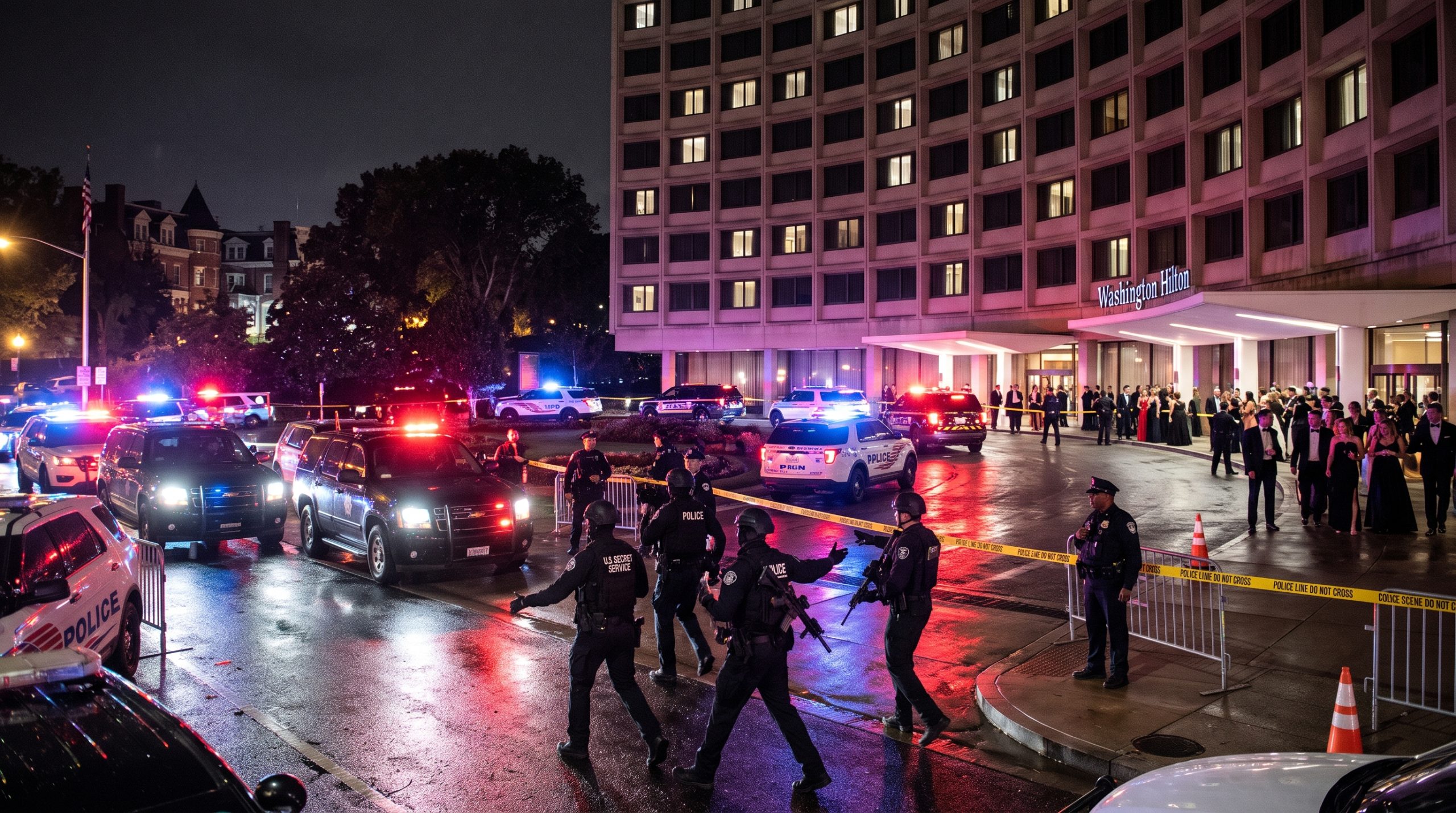
WASHINGTON — A black-tie gathering of the nation’s political, journalistic, and diplomatic leadership descended into violent turmoil on Saturday evening, April 25, 2026, when an armed assailant breached a federal security checkpoint inside the Washington Hilton and opened fire, striking a United States Secret Service officer at point-blank range before being subdued steps from the main ballroom.
The violent intrusion triggered an instantaneous tactical evacuation of President Donald Trump, high-ranking cabinet secretaries, congressional leaders, and visiting foreign dignitaries, abruptly ending the annual White House Correspondents’ Association dinner and precipitating an expansive federal criminal indictment.
Federal prosecutors identified the defendant as Cole Tomas Allen, 31, of Torrance, California. According to charging documents filed in the U.S. District Court for the District of Columbia, Allen approached the Secret Service’s primary magnetometer checkpoint situated on the hotel’s lower Terrace Level at approximately 8:35 p.m., openly carrying a 12-gauge pump-action shotgun before lunging past screening stations toward a subterranean access corridor leading into the banquet hall.
Point-Blank Gunfire at the Magnetometers
According to investigative affidavits, the armed confrontation unfolded in a matter of seconds. As private guests and credentialed attendees queued for routine physical screening, Allen charged past the magnetometers, bypassing security stanchions.
When a uniformed Secret Service officer moved forward to intercept him, Allen leveled a Mossberg Maverick 88 12-gauge shotgun and discharged a direct round into the officer’s chest.
Law enforcement officials confirmed that the officer’s concealed, multi-layered ballistic vest absorbed the impact of the shotgun blast, preventing fatal penetrating trauma to his vital organs. Despite the severe blunt-force trauma from the close-range blast, the wounded officer managed to draw his standard-issue service weapon and discharge five defensive rounds.
Allen was not struck by the return fire. The force of the immediate exchange caused him to stumble and fall to the carpeted foyer, where he suffered a minor knee laceration before being swarmed and physically pinned to the floor by arriving tactical agents and Metropolitan Police Department personnel.
As gunshots echoed across the Terrace Level, presidential protective details inside the ballroom initiated emergency egress maneuvers. Secret Service agents formed a protective human shield around Trump, rushing him into a fortified subterranean exit passage before transporting him by armored motorcade to the White House complex. Simultaneously, tactical squads directed hundreds of attendees—including lawmakers, corporate executives, and international journalists dressed in formal evening wear—into lockdown posture across reinforced service basements and utility tunnels.
A search of Allen’s person and gear bags uncovered a substantial cache of weapons and tactical tools. Agents seized the 12-gauge shotgun, a loaded .38-caliber revolver, dozens of rounds of assorted ammunition, two fixed-blade utility knives, four daggers, modular tactical sheaths, high-tensile wire cutters, and heavy-duty pliers.
Indictment Details Deliberate Cross-Country Transit
Court documents unsealed by the Justice Department suggest weeks of calculated operational planning. Federal investigators established that Allen had reserved a three-night stay at the Washington Hilton, spanning April 24 through April 26, strategically positioning himself within the physical venue host of the presidential event.
Investigators tracing Allen’s transit confirmed that he departed Southern California by passenger train, transiting through Chicago before arriving at Washington’s Union Station on the eve of the dinner. Hotel records show he checked into a guest room on the upper floors without raising suspicion.
Firearm trace records compiled by the Bureau of Alcohol, Tobacco, Firearms and Explosives revealed that Allen had legally purchased both weapons in California—the .38-caliber revolver in October 2023 and the shotgun in August 2025. Federal investigators also recovered encrypted communications and digital notes authored by Allen prior to the incident, which prosecutors are introducing to demonstrate premeditation and intent to eliminate executive leadership.
A federal grand jury returned a four-count felony indictment charging Allen with:
-
Attempted assassination of the President of the United States
-
Assault on a federal officer with a dangerous and deadly weapon
-
Discharging a firearm during and in relation to a crime of violence
-
Interstate transportation of firearms and ammunition with intent to commit a felony
Appearing in federal court through assigned counsel, Allen entered a plea of not guilty to all counts. Under constitutional protections, he remains presumed innocent unless proven guilty beyond a reasonable doubt in a court of law.
Severe Scrutiny Falls on Hotel Security Perimeters
The violent breach has triggered an immediate, high-level review of executive security perimeters at public commercial venues, focusing heavily on hotel architecture and early-warning screening protocols.
While federal magnetometers and armed checkpoints operated as designed on the Terrace Level by stopping Allen from gaining entry to the ballroom, congressional oversight committees and independent security consultants have raised sharp questions regarding how an individual carrying an exposed long gun could navigate internal elevators, secondary stairwells, and public lobby corridors undetected prior to encountering the screening threshold.
The incident carries a profound historical resonance for the capital and the nation. The Washington Hilton is the site of the March 30, 1981, assassination attempt against President Ronald Reagan by John Hinckley Jr., a defining moment that overhauled federal executive protection protocols and mandated permanent secure zones for presidential arrivals. Forty-five years later, the same historic complex became the stage for another near-disaster that pushed federal protective defenses to the brink.
As the legal proceedings move forward, the breach underscores the persistent security risks that accompany high-density presidential galas, showing how quickly a routine gathering of state officials can transform into an active tactical combat zone.