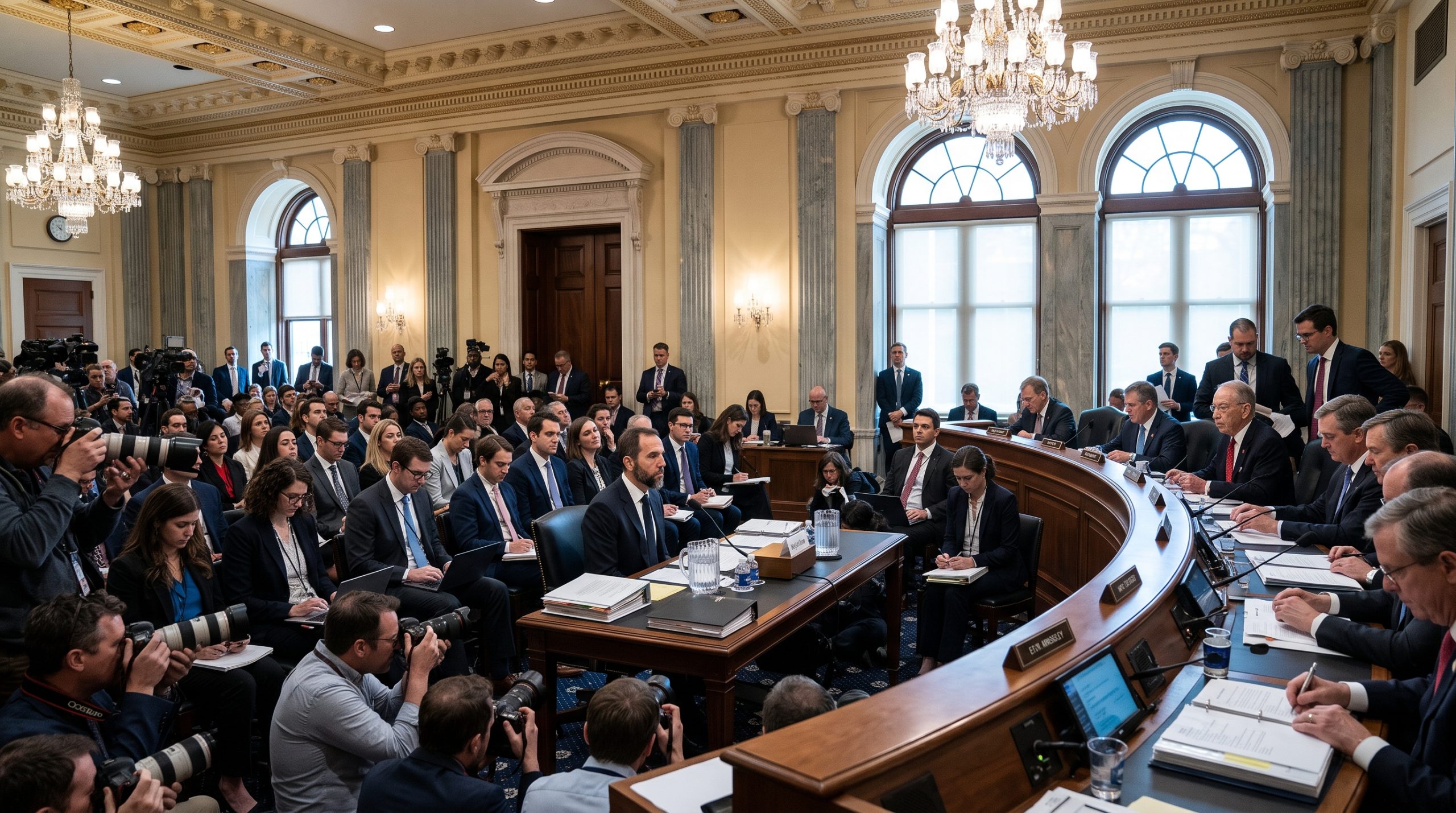
WASHINGTON — A contentious Senate Judiciary Committee hearing examining former special counsel Jack Smith took an unexpected detour when Republican Sen. Eric Schmitt of Missouri confronted Smith over an alleged clandestine trip to an Atlanta Hawks basketball game. Intended as a calculated line of inquiry into potential coordination between federal and state prosecutors investigating President Donald Trump, the confrontation dissolved into widespread public embarrassment after an apparent conflation between professional and collegiate basketball teams undermined the senator’s central premise.
The clash erupted during a daylong hearing on September 29, 2026, in which Republican lawmakers questioned Smith under oath regarding his oversight of dual federal investigations into Trump. Schmitt pressed the former prosecutor on whether he had traveled to Atlanta in February 2024 to attend an NBA contest, suggesting the outing served as cover for an undisclosed meeting with Fulton County District Attorney Fani Willis, who was simultaneously leading a state-level racketeering prosecution against Trump over the 2020 election.
Brandishing what he described as recovered text exchanges among members of the special counsel’s trial team, Schmitt demanded to know Smith’s whereabouts on the date in question. Smith categorically denied traveling to Georgia or attending an Atlanta Hawks game, countering with a straightforward recollection: he had attended a women’s college basketball game featuring the University of Iowa Hawkeyes against the University of Maryland Terrapins in College Park, Maryland.
The semantic and geographic gulf between an NBA arena in downtown Atlanta and a Big Ten women’s basketball venue just miles outside the District of Columbia instantly altered the trajectory of the proceeding.
Anatomy of a Premature Accusation
Schmitt’s inquiry targeted a politically volatile window in early 2024, when Willis was facing sustained public scrutiny and disqualification motions regarding her personal relationship with Nathan Wade, a special prosecutor she had appointed to lead the Georgia election-interference case. Congressional Republicans had long sought evidence to substantiate theories that federal authorities coordinated covertly with local prosecutors in Atlanta and New York to orchestrate overlapping legal pressure on Trump.
The senator appeared to believe that text messages mentioning attendance at a “Hawks” game placed Smith inside State Farm Arena in Atlanta, creating a plausible timeline for backchannel consultations with local prosecutors.
Smith dismantled the foundation of the question with measured precision. Rather than an NBA event in Georgia, Smith stated, he had secured tickets to watch Iowa’s collegiate squad—headlined at the time by collegiate scoring sensation Caitlin Clark—play on the road at Maryland’s Xfinity Center.
Sen. Amy Klobuchar, a Minnesota Democrat on the panel, intervened to clarify the apparent misapprehension, pointing out the linguistic and logistical difference between the Atlanta Hawks of the National Basketball Association and the Iowa Hawkeyes of the NCAA. Her intervention underscored the likelihood that an informal reference to the Hawkeyes in staff text messages had been misinterpreted by congressional investigators as a reference to the Atlanta franchise.
The clarification stripped Schmitt’s assertion of evidentiary support. No contemporaneous records, flight logs, or corroborating communications placed Smith in Atlanta, leaving the insinuation of an unrecorded meeting with Willis completely unsupported on the hearing record.
Perjury Threat Complicates Congressional Push
The exchange escalated further when Schmitt pressed the matter, suggesting that Smith was being evasive under oath and floating the prospect of criminal perjury referrals.
Levying perjury accusations against a career federal prosecutor testifying before a congressional committee represents a severe procedural escalation. However, the obvious geographic and nomenclature error rapidly shifted the political liability back onto the committee’s majority staff, transforming what was intended to be an adversarial cross-examination into a demonstration of unvetted investigative assumptions.
Footage of the exchange circulated immediately across cable news broadcasts and social media platforms, where commentators focused on the stark contrast between the gravity of the legal allegations and the basic factual error underpinning them. The moment overshadowed hours of detailed testimony regarding federal subpoenas, grand jury protocols, and the deployment of federal law enforcement assets.
Schmitt subsequently sought to minimize the fallout, asserting that lawmakers possess a constitutional responsibility to question witnesses rigorously based on staff-obtained records and that the witness had placed his explanation on the record. Yet the defense did little to dispel the perception that committee aides had rushed an explosive claim into public view without verifying basic facts.
Institutional Scrutiny and the Legacy of the Trump Probes
The hearing formed part of a broader congressional review led by Capitol Hill Republicans into Smith’s tenure as special counsel. Appointed by Attorney General Merrick Garland in late 2022, Smith spearheaded federal indictments concerning Trump’s post-presidency retention of classified documents at Mar-a-Lago and his efforts to contest the certification of the 2020 election results.
Both federal prosecutions were formally dismissed prior to trial following Trump’s victory in the 2024 presidential election, consistent with long-standing Justice Department policy prohibiting the criminal indictment or trial of a sitting president. Trump and his congressional allies have consistently framed the investigations as partisan lawfare weaponized by the executive branch. Smith has maintained that his office operated strictly within statutory boundaries, governed by grand jury evidence and non-partisan departmental guidelines.
Throughout the session, Republican members focused on technical investigative steps taken by the special counsel’s office, including the use of administrative subpoenas to review communications metadata associated with members of Congress. Democratic lawmakers defended the integrity of the federal proceedings, accusing Republicans of staging retrospective hearings designed to impugn the credibility of federal law enforcement.
A Cautionary Tale for Congressional Inquiries
The Hawks-Hawkeyes dispute highlighted the perils facing congressional investigators during high-stakes public hearings. Congressional oversight functions effectively when committees challenge official witnesses through thoroughly verified documentary evidence and rigorous cross-examination. When an inquiry relies on uncorroborated interpretations of informal messages, even minor factual errors can completely derail the credibility of an investigation.
While the broader debate over prosecutorial discretion and executive accountability remains deeply entrenched along partisan lines, the botched questioning underscored how a simple confusion between college athletics in Maryland and professional basketball in Georgia can puncture the most ambitious congressional narrative.