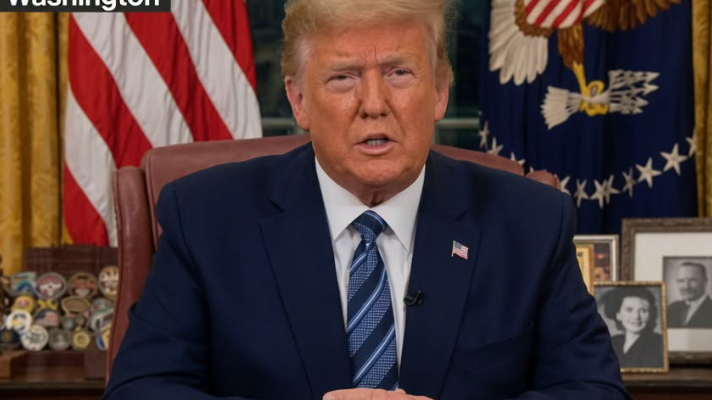
WASHINGTON — President Donald Trump has warned that the United States could dramatically expand its military campaign against Iran’s energy infrastructure if Tehran fails to reach an acceptable agreement and restore unrestricted shipping through the Strait of Hormuz.
In a post Sunday on Truth Social, Trump said Washington was engaged in “serious discussions” with what he described as a “new, and more reasonable” Iranian regime. He suggested that significant progress had been made toward a potential agreement but warned that the United States would take additional military action if negotiations failed.
Trump specifically threatened strikes against Iranian electricity-generating facilities, oil infrastructure and Kharg Island, a major hub for the country’s petroleum exports. He also raised the possibility of targeting desalination facilities, while saying those sites had so far been deliberately spared to allow room for diplomacy.
The warning came as senior administration officials continued signaling that Washington hopes to bring the conflict to an end within weeks.
Secretary of State Marco Rubio said Friday that U.S. military operations could conclude in “weeks, not months,” consistent with earlier estimates that the campaign would last roughly four to seven weeks. Speaking after meetings with Group of Seven foreign ministers in France, Rubio said the administration had received messages from Iran indicating a possible willingness to negotiate.
However, significant uncertainty remains over who would represent Tehran and what authority any negotiating delegation would possess.
“We’re waiting for further clarification,” Rubio said, according to the BBC, as Washington seeks details about potential talks.
15-Point Proposal Under Consideration
The diplomatic push comes as the Trump administration has reportedly presented Iran with a 15-point proposal intended to establish terms for ending the conflict.
Special envoy Steve Witkoff said he remained hopeful that negotiations could begin soon, describing the proposal as potentially capable of resolving the war.
Trump has previously said he paused planned attacks on Iranian power infrastructure to give negotiations an opportunity to succeed.
The conflict began February 28 with coordinated U.S. and Israeli military operations targeting Iranian military and strategic capabilities. The fighting has since resulted in the deaths of senior Iranian leaders and prompted Tehran to threaten retaliation against American and Israeli interests.
Iranian Foreign Minister Abbas Araghchi has accused Israel of striking nuclear facilities and industrial infrastructure and warned that Tehran would impose a heavy price in response.
The Islamic Revolutionary Guard Corps has likewise threatened attacks against infrastructure associated with the United States and Israel, raising concerns that the conflict could spread throughout the region.
Strait of Hormuz Remains Critical
One of the most urgent issues is the status of the Strait of Hormuz, a narrow but strategically vital waterway through which roughly one-fifth of global oil and liquefied natural gas supplies normally pass.
The G7 has called for unrestricted navigation through the strait, while reports indicate that Iran has imposed restrictions and may be charging some vessels for passage.
For Washington, reopening the waterway is now closely tied to the broader diplomatic effort.
The coming weeks could therefore prove decisive. If negotiations produce an agreement, the conflict could begin moving toward de-escalation. If talks collapse, Trump’s warning suggests the United States is prepared to intensify pressure on Iran’s energy and industrial infrastructure, potentially creating a much wider regional crisis.