A reported late-night sighting of President Donald Trump has triggered a wave of online speculation after social-media accounts claimed he was seen walking alone shortly after midnight.
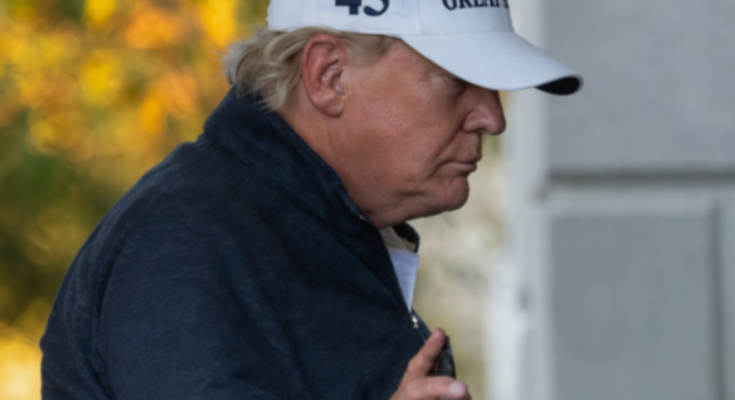
According to the accounts circulating online, Trump was reportedly wearing a baseball cap and appeared without the large security presence, cameras or public announcement typically associated with his movements. Attention quickly shifted to a small object allegedly visible in his hand, with some observers claiming it briefly reflected light beneath nearby streetlamps.
The limited information surrounding the alleged sighting created an immediate opening for speculation. Rather than focusing on what could actually be established, online discussions quickly turned toward theories about what the object might have been and why Trump was reportedly walking at such a late hour.
However, few details connected to the account have been independently confirmed. There was no clear information establishing the exact location, the circumstances of the encounter or the identity of the person who originally documented it. Without those details, interpretations of the incident remain uncertain.
That uncertainty did little to slow the conversation.
Some social-media users suggested that the object Trump was allegedly carrying could have been significant, while others interpreted the reported sighting as evidence of something more consequential. Still others questioned whether the incident was being exaggerated simply because of the president’s highly visible public status.
The episode demonstrates how quickly an ambiguous image or unverified eyewitness account can become a larger online narrative.
Public figures routinely attract extraordinary attention, and even ordinary activities can become subjects of intense scrutiny. Walking outside, wearing casual clothing or carrying an unidentified object might be completely unremarkable for an ordinary person. When the individual involved is a sitting president, however, seemingly minor details can take on an entirely different significance.
When Uncertainty Becomes the Story
The most revealing aspect of the reported sighting may therefore be less about what Trump was allegedly doing and more about how people responded to incomplete information.
When facts are limited, people often fill the gaps with assumptions shaped by their existing beliefs. Supporters may interpret an unexplained event positively, while critics may view the same information with suspicion. In both cases, the available evidence can become secondary to the narrative people construct around it.
Social media can accelerate that process. A grainy photograph, short video or unverified post can be shared thousands of times before anyone establishes its origin or confirms the circumstances surrounding it. Repetition can then create the appearance of credibility, even when the underlying information remains unverified.
The reported midnight encounter also illustrates the difference between curiosity and evidence.
There is nothing inherently suspicious about a public figure appearing outside normal public schedules. Nor does an unidentified object automatically indicate that something unusual occurred. Without reliable documentation or official confirmation, conclusions about the meaning of the sighting remain speculative.
For readers, the incident offers a familiar lesson in navigating viral information: an unanswered question is not necessarily evidence of a hidden story.
Until credible sources establish where, when and under what circumstances the alleged sighting occurred, the responsible approach is to treat the claims cautiously.
In the end, the most significant story may not be what Trump was carrying or why he was reportedly walking after midnight. It may be how quickly uncertainty itself became the fuel for a much larger online narrative.