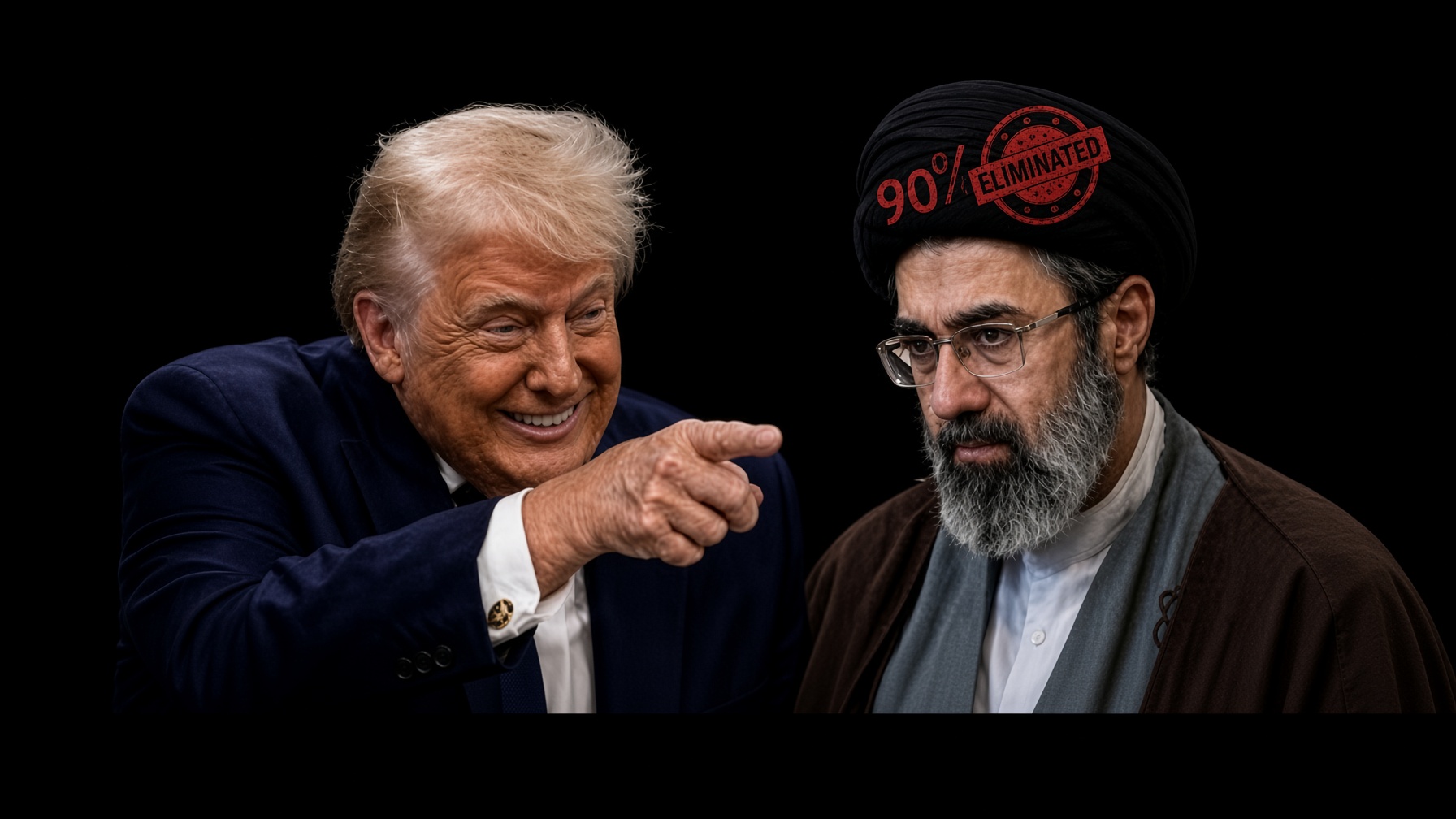
WASHINGTON — President Donald Trump asserted Monday that Iran’s Supreme Leader, Mojtaba Khamenei, is “90% gone” in the wake of an extensive, multi-wave American air and missile campaign, delivering an uncorroborated assessment of the cleric’s physical condition as the military confrontation between Washington and Tehran escalates to unprecedented thresholds.
The remarks, delivered as United States Central Command (CENTCOM) prosecutes high-intensity combat sorties against command nodes and missile infrastructure across the Islamic Republic, represent the most direct claim by an American commander-in-chief regarding the targeted vulnerability of Iran’s clerical and military apex.
However, the assertion immediately confronted a profound intelligence vacuum. Independent international monitors, commercial satellite analysis firms, and allied foreign intelligence agencies have offered no independent verification of the claim. In Tehran, state media networks maintained strict operational silence regarding the supreme leader’s physical condition and precise geographic coordinates, instead broadcasting continuous rotations of nationalist programming, martial hymns, and standardized diplomatic denunciations of Western aggression.
Rhetoric Collides With the Fog of War
Addressing reporters regarding the ongoing air campaign, Trump characterized the operation as a crushing, systemic blow to the regime’s supreme command hierarchy, suggesting that coordinated bombardments had pushed the cleric to the brink of physical or operational collapse.
“He is 90% gone,” Trump declared, declining to elaborate on whether the assessment derived from real-time battle-damage assessments (BDA), intercepted signals intelligence (SIGINT), or human intelligence assets operating within the Iranian security apparatus.
The White House and the Pentagon declined to release underlying intelligence dossiers or declassified reconnaissance data to substantiate the president’s characterization. Iranian diplomatic missions abroad and spokespersons for the Supreme National Security Council offered no confirmation of injury, medical evacuation, or death involving Khamenei.
National security analysts and former intelligence officials urged analytical caution, noting that in the opening stages of theater-wide military operations, public political rhetoric frequently outpaces forensic intelligence verification. Determining the precise physical fate of deeply fortified, highly mobile foreign leaders during an active bombardment remains one of the most complex tasks facing the intelligence community, particularly when targeted adversaries enforce strict electronic emissions control and information blackouts.
Systematic Degradation of Strategic Infrastructure
The president’s remarks follow what defense officials describe as an expansive, precision-guided campaign orchestrated to dismantle Tehran’s offensive projection assets and neutralize its layered perimeter defenses. American strike packages, comprising long-range standoff bombers, carrier-based strike fighters, and naval cruise missiles, have targeted dozens of hardened installations:
-
Integrated Air-Defense Networks: Neutralizing early-warning radar installations, command batteries, and Russian-origin surface-to-air missile platforms to secure unrestricted coalition air superiority over central transit corridors.
-
Ballistic and Cruise Missile Complexes: Striking hardened subterranean storage silos, propellant manufacturing facilities, and automated transporter-erector-launcher (TEL) garrisons positioned across western and central Iran.
-
Command, Control, and Communications (C3) Nodes: Leveling reinforced subterranean bunkers, tactical relay towers, and command posts linked to the Islamic Revolutionary Guard Corps (IRGC) senior leadership.
-
Maritime Interdiction and Drone Assets: Bombarding coastal fast-attack naval pens, unmanned aerial vehicle (UAV) manufacturing plants, and mobile anti-ship cruise missile positions overlooking the Persian Gulf and the Gulf of Oman.
Senior defense officials have framed the sorties as preventative operations intended to shatter Tehran’s operational capability to execute asymmetric counter-salvos against forward-deployed U.S. forces, regional partners, and commercial shipping. The comprehensive strategic and infrastructural damage remains difficult to verify independently, as smoke plumes linger over targeted military reservations and Iranian security services strictly suppress domestic reporting and civilian internet access.
Succession Politics and Constitutional Fragility
Trump’s assertion has introduced acute geopolitical volatility into Iran’s domestic succession dynamics. Under the constitutional framework of the Islamic Republic, the supreme leader exercises ultimate, unreviewable command over the armed forces, dictates strategic foreign policy, and serves as the final arbiter between competing political and clerical factions.
The sudden incapacitation or death of the supreme leader under foreign bombardment would precipitate an unprecedented institutional and constitutional stress test. While the Iranian constitution assigns the 88-member Assembly of Experts the formal mandate to deliberate and select a successor, an emergency transition executed under wartime conditions would inevitably accelerate the IRGC’s domestic ascendancy, effectively transforming the succession into a hardline consolidation for regime survival.
Diplomatic envoys warn that an unconfirmed leadership vacuum severely impairs crisis de-escalation channels. Without a recognized, centralized authority capable of authorizing an operational ceasefire or strategic pause, regional command units and localized IRGC commands may act autonomously, significantly escalating the danger of erratic retaliatory strikes and unconstrained theater-wide miscalculation.
Economic Instability Across Global Transit Corridors
The widening military campaign and accompanying leadership uncertainty continue to reverberate across international commodities exchanges and maritime transport routes. Commercial maritime operators traversing the Strait of Hormuz—the vital chokepoint through which approximately 20 percent of global petroleum transit flows—have initiated emergency risk protocols, with several major shipping conglomerates rerouting vessels around the Cape of Good Hope.
Marine insurance syndicates have responded by elevating war-risk insurance premiums to historic peaks, compounding transport costs and fueling volatility across global energy indices. While allied capitals emphasize that securing freedom of navigation remains an unalterable strategic imperative, Gulf Cooperation Council (GCC) governments have expressed acute concern over the risk of regional contagion, intensifying backchannel diplomacy while hardening their domestic air defense architectures.
The strategic theater remains suspended in high-stakes ambiguity. As intelligence analysts process high-resolution satellite imagery, electronic intercepts, and human intelligence streams, the veracity of Washington’s declarations—and the operational durability of Tehran’s governing command—will decide whether the confrontation settles into an uneasy standoff or expands into an unmanageable regional war.