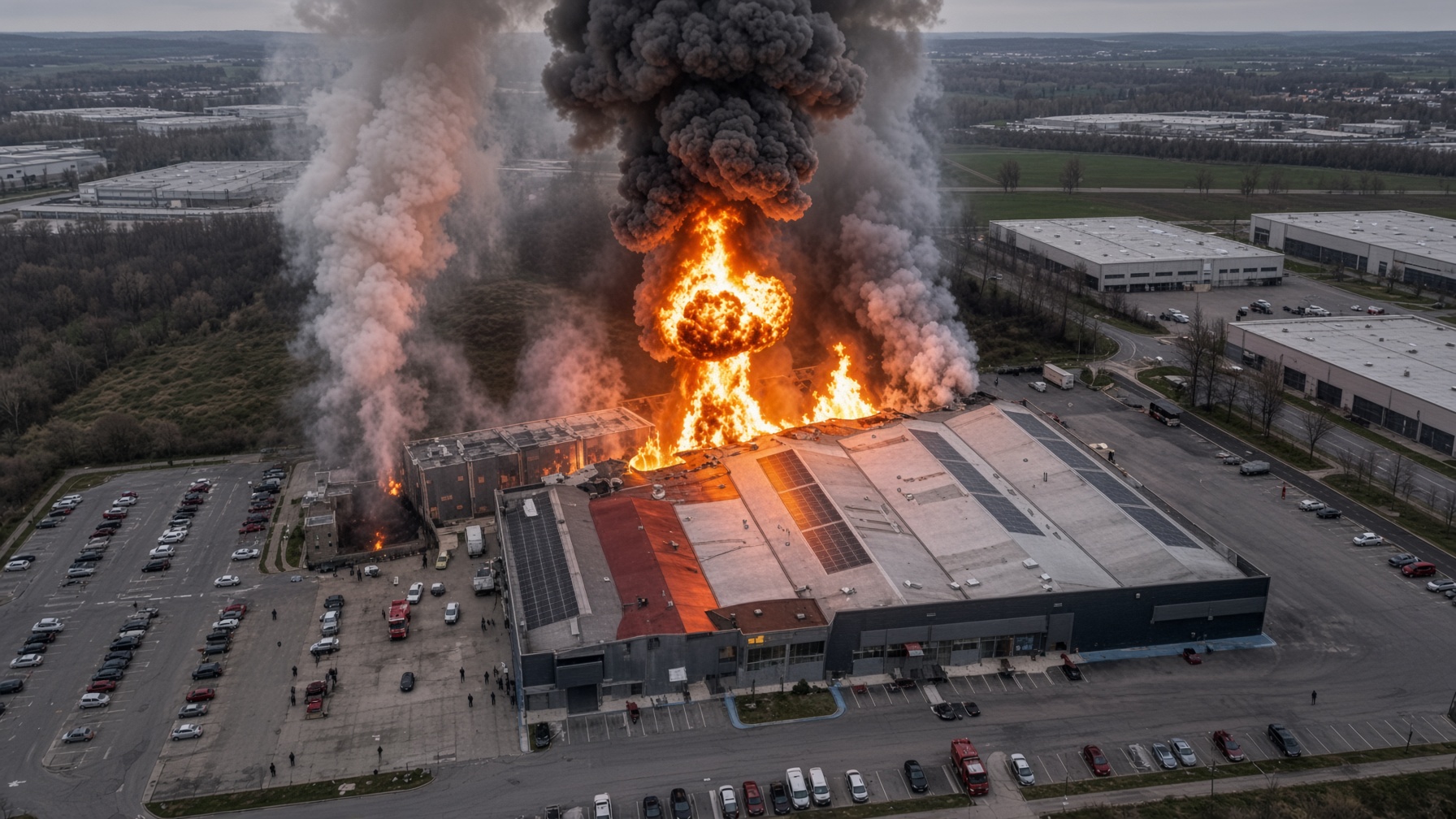
TRIKALA, Greece — A catastrophic fire swept through a major commercial biscuit manufacturing plant near Trikala in central Greece early Monday morning, killing four factory workers and injuring seven others in one of the country’s deadliest industrial accidents in recent years.
The blaze erupted shortly after 4:00 a.m. local time inside the primary production complex of Violanta, a prominent domestic confectionery and baked-goods manufacturer situated roughly 200 miles north of Athens. Thirteen employees were on-site staffing the facility’s overnight production line when flames rapidly engulfed the main operating floor.
Emergency rescue teams managed to evacuate eight personnel from the burning structure as thick black smoke billowed across the regional agricultural plain. Following an intensive containment operation, search-and-rescue teams entering the charred facility recovered the remains of four workers trapped inside. One additional worker was initially listed as unaccounted for during early recovery sweeps before emergency manifests were reconciled.
Massive Emergency Response Mobilized
The Hellenic Fire Service dispatched a major regional response, deploying approximately 40 specialized firefighters, 15 emergency engines, and specialized ladder units to combat the structural blaze.
First responders faced extreme internal temperatures and compromised roof trusses as flames burned through synthetic ceiling insulation and compromised industrial ventilation ducts. Plumes of acrid smoke severely restricted visibility along adjacent roadways, prompting local traffic police to establish a safety perimeter around the industrial park.
Regional emergency medical services transported seven individuals—six factory workers suffering from acute smoke inhalation and thermal burns, alongside one responding firefighter injured during suppression efforts—to the General Hospital of Trikala for emergency treatment. Health authorities confirmed the patients remain under observation in stable condition.
Forensic Teams Probe Structural Origin
Greek judicial authorities, alongside the Fire Service’s Arson Crimes Division, have launched a comprehensive criminal and technical inquiry to determine the exact origin of the blaze.
Preliminary eyewitness statements gathered from surviving shift workers described a sudden concussive blast echoing from the mechanical mixing and baking sections immediately before flames spread across the interior. However, state forensic engineers cautioned that it remains too early to confirm whether an accidental mechanical explosion triggered the fire or if a rapid electrical flare initiated secondary industrial explosions.
Specialized arson investigators and mechanical engineers are conducting a methodical grid search through the ruins. The inquiry will focus on:
-
Industrial baking ovens and high-voltage electrical panels for signs of catastrophic short circuits or component failure.
-
Pneumatic lines and combustible dust accumulation, which pose distinct fire hazards in commercial grain and flour processing environments.
-
Maintenance and calibration logs for automated thermal cut-offs and fire dampers.
-
Digital records and physical wreckage from the facility’s automated overhead water-sprinkler systems to verify whether suppression countermeasures activated upon alarm.
Authorities cautioned against circulating speculative accounts regarding equipment neglect, emphasizing that definitive conclusions will depend on physical evidence recovery and digital surveillance analysis.
Corporate Statement and Safety Oversight
Violanta executives issued a formal statement expressing profound grief over the loss of life and pledging complete, transparent cooperation with state investigators.
Company leadership affirmed that psychological counseling services, financial support, and logistical assistance are being mobilized immediately for the victims’ families and surviving staff. Representatives reiterated that the company’s manufacturing plants operate under strict compliance with domestic and European Union industrial safety standards.
Food processing and confectionery plants fall under stringent European health and occupational safety frameworks, requiring dual-redundancy firebreaks, zoned extraction systems, certified evacuation routes, and regular municipal inspections. Industrial safety specialists noted that while the successful evacuation of eight workers indicates active alarm signaling and functional fire doors, the speed with which the structure was consumed warrants an exhaustive engineering audit.
Community Stunned by Industrial Tragedy
The disaster has sent shockwaves through Trikala and surrounding Thessalian municipalities, where the Violanta plant serves as a cornerstone regional employer and economic engine.
Local labor syndicates and municipal leaders expressed deep condolences to the bereaved households while calling for a swift, thorough investigation into workplace safety compliance across regional industrial zones. Municipal social-service agencies have established emergency support desks to assist affected families, while regional prosecutors prepare formal subpoenas for the plant’s operational safety certifications.