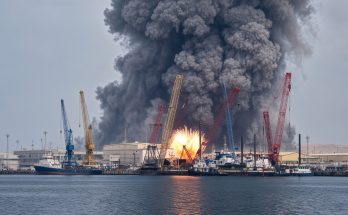
INTERNATIONAL DESK — Unverified reports alleging a successful kinetic strike against a heavily fortified surface combatant have triggered intense scrutiny across international defense ministries, reigniting an urgent strategic debate over the operational limits of shipboard integrated air-defense networks against next-generation anti-ship munitions.
The claims, which proliferated rapidly across digital channels alongside degraded video clips and disjointed audio fragments, allege that an inbound aerial weapon pierced multiple defensive layers to strike a capital warship operating in contested waters. Yet major naval headquarters, sovereign defense ministries, and commercial maritime intelligence services have maintained complete institutional silence. Essential operational details—the vessel’s hull classification, its flag state, the nature of the incoming munition, and whether the platform sustained hull breaches, fires, or personnel casualties—remain uncorroborated by primary evidence.
In the absence of high-resolution commercial satellite imagery, official damage-control disclosures, or verifiable tactical tracking data, seasoned naval analysts and electronic-warfare specialists caution against accepting viral battle reports as confirmed military outcomes.
The Mechanics of Integrated Fleet Defense
Modern surface combatants—ranging from guided-missile destroyers and air-warfare frigates to cruisers and carrier task forces—do not operate as isolated targets. Instead, they rely on complex, multi-tiered combat architectures designed to neutralize inbound threats through sequential intercept envelopes:
-
Outer-Tier Surveillance and Long-Range Intercepts: Solid-state active electronically scanned array (AESA) radar suites and cooperative airborne surveillance platforms sweep the littoral expanse hundreds of miles out. These sensors detect ballistic arcs or sea-skimming trajectories, cuing long-range surface-to-air interceptors to neutralize hostiles well before they achieve visual or terminal acquisition of the fleet.
-
Medium-Range Area Defense and Soft-Kill Countermeasures: Weapons that survive the long-range umbrella encounter intermediate-range interceptors paired with high-powered active electronic attack pods. Shipboard jammers emit targeted electromagnetic noise to blind missile seekers, while automated mortars launch chaff corridors and infrared flare decoys to pull terminal guidance systems away from the ship’s physical silhouette.
-
Terminal Point-Defense and Close-In Weapon Systems (CIWS): Inside the ultimate tactical perimeter, autonomous rapid-reaction missiles and multi-barrel rotary cannons capable of firing thousands of rounds per minute unleash a wall of tungsten fragmentation to physically disintegrate surviving “leakers” seconds before impact.
Despite the sophistication of these integrated suites, fleet architects acknowledge that no defensive perimeter guarantees total invulnerability. Tactical survivability is governed by complex physical and environmental variables: missile velocity, radar cross-section, low-altitude wave-skimming profiles, terminal evasive maneuvers, sea clutter, radar horizon constraints, and processor latency.
More critically, contemporary offensive doctrines increasingly emphasize weapon saturation. By launching synchronized multi-axis attacks that pair low-cost loitering drones, radar-homing decoys, high-speed cruise missiles, and steep-angle anti-ship ballistic projectiles, an adversary attempts to exhaust a combat system’s computing bandwidth and drain its vertical launch system (VLS) cell capacity, creating fleeting openings for a single warhead to penetrate.
Information Warfare and the Digital Fog of Sea Combat
The ambiguity surrounding the alleged strike illustrates the heightened friction of contemporary open-source intelligence environments, where digital claims frequently outpace verified facts from the theater of operations.
Within hours of the initial assertions, anonymous monitoring channels circulated grainy clips purported to depict secondary magazine explosions, listing decks, and emergency fire-suppression efforts. Open-source researchers and forensic image analysts swiftly dismantled several of these files, demonstrating that key clips had been recycled from past naval accidents, commercial tanker blazes, or unclassified live-fire training exercises and redistributed without temporal context.
Naval clashes in restricted waterways remain acutely vulnerable to deliberate narrative manipulation and premature speculation. Operational commands maintain rigorous communications discipline during and immediately following combat contacts. Fleet commanders routinely enforce strict electronic emission control (EMCON) and prioritize crew accountability, damage-control assessments, and tactical repositioning long before military public affairs offices formulate public debriefs.
Independent defense observers emphasize that until commercial synthetic aperture radar (SAR) satellites or multi-spectral optical platforms record clear imagery of the vessel in question—either underway under its own power, engaged in harbor-side repairs, or exhibiting scorch patterns—it is impossible to confirm whether an impact occurred or if defensive interceptors merely downed a target harmlessly off the ship’s beam.
Doctrinal Implications for Modern Surface Fleets
If validated by concrete physical or administrative evidence, a confirmed penetration of a frontline warship’s defensive cordon would carry profound operational and doctrinal consequences for maritime powers worldwide.
Naval tacticians and defense contractors would immediately deconstruct every second of the engagement timeline. Investigators would seek to determine whether the penetration stemmed from radar sensor degradation, electronic countermeasure failure, algorithmic targeting saturation, mechanical interceptor malfunctions, or basic magazine depletion following a prolonged defensive volley.
The controversy highlights the relentless technological race dominating maritime warfare. Over the past decade, anti-ship cruise missiles have incorporated stealth shaping, autonomous target recognition, and supersonic dashes, while terminal-phase ballistic anti-ship missiles descend at hypersonic speeds along high-angle trajectories designed to exploit the vertical blind spots of conventional shipboard arrays.
Naval forces have raced to counter these innovations by deploying advanced digital jamming arrays, testing shipboard directed-energy lasers, and expanding Cooperative Engagement Capability (CEC) networks that permit warships to fire interceptors using targeting tracks calculated by distant reconnaissance aircraft.
For now, the purported strike remains confined to uncorroborated digital channels. Allied battle groups continue standard patrols, naval logistics commands report no emergency diversions, and maritime analysts emphasize that until verifiable physical wreckage, official casualty notices, or undisputed satellite surveys emerge, claims of a breached fleet defense represent speculative digital rumor rather than confirmed naval history.