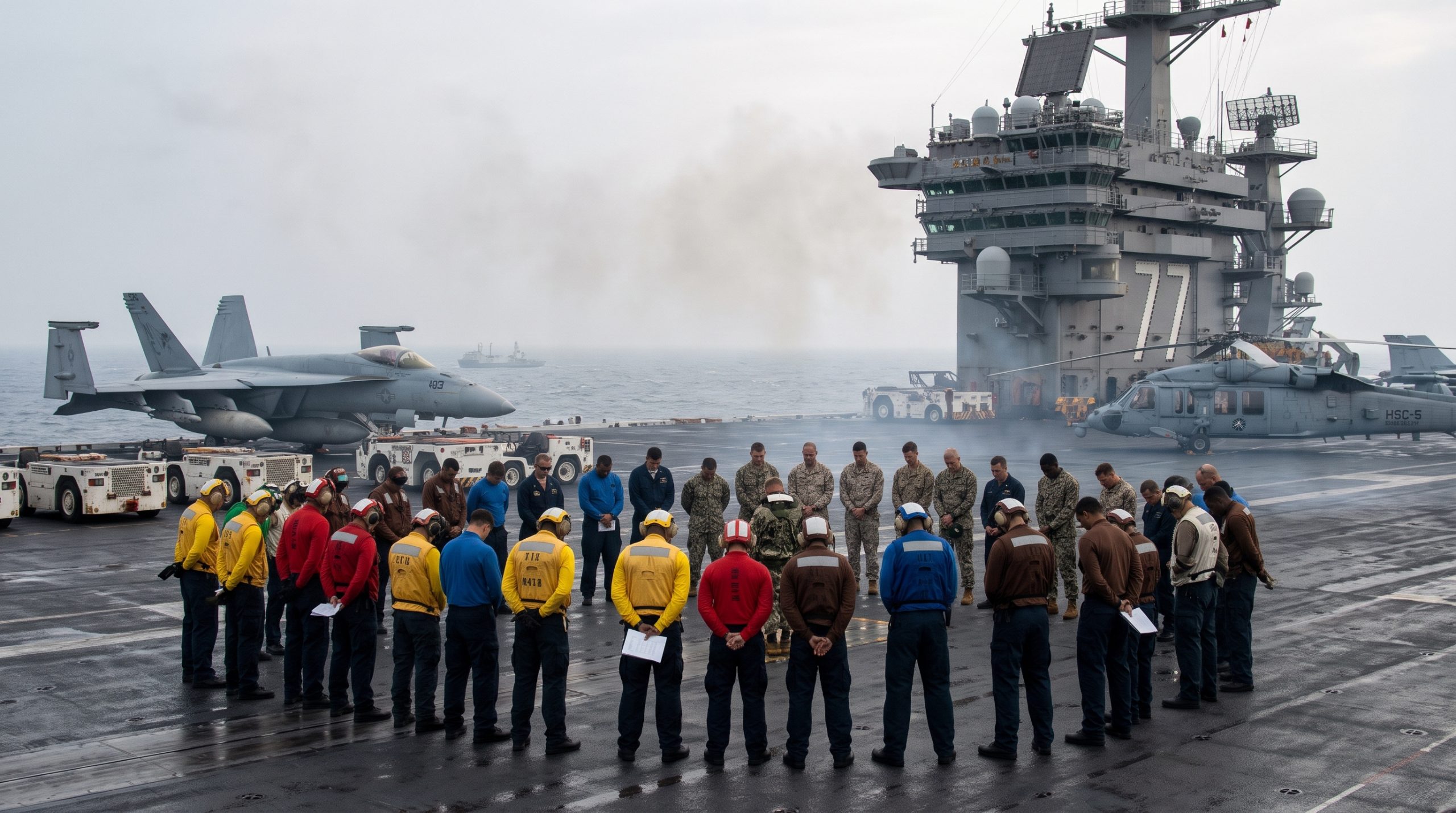
MANAMA, Bahrain — An extensive, multi-day naval search-and-rescue operation across the northern Arabian Sea ended without recovery over the weekend, as U.S. 5th Fleet commanders formally suspended efforts to locate a senior aviator who vanished following an emergency water landing by an MH-60S Sea Hawk helicopter, defense officials announced.
The active recovery effort was halted following more than 102 continuous hours of combined aerial and maritime operations spanning roughly 14,000 square miles of open sea. Following the completion of mandatory 48-hour next-of-kin notification procedures, U.S. Naval Forces Central Command identified the missing officer as Cmdr. Gabriel Edwards, the commanding officer of Helicopter Sea Combat Squadron 5 (HSC-5), the storied carrier-based unit known across the fleet as the “Nightdippers.”
Three other crew members aboard the aircraft were successfully pulled from the sea by forward naval search units within minutes of the ditching on July 1, 2026. The rescued sailors, returned to the USS George H.W. Bush in stable condition, suffered minor injuries and non-life-threatening exposure before being transferred for medical evaluation.
A Coordinated Theater Search Grid
The incident began during routine daytime maneuvers in international airspace over the Arabian Sea. The multi-mission rotary aircraft—assigned to Carrier Air Wing 7 embarked aboard the Nimitz-class aircraft carrier USS George H.W. Bush—experienced an acute, catastrophic mechanical failure in flight that forced the pilots to initiate an immediate controlled water landing.
Emergency acoustic beacons and radio locator pings triggered an immediate mass response from Task Force 50, drawing frontline surface and aviation assets from two carrier strike groups operating across the region:
-
Fixed-Wing Reconnaissance: U.S. Navy P-8A Poseidon maritime patrol aircraft conducted systematic radar sweeps across expansive offshore grids, utilizing synthetic aperture sensors and forward-looking infrared (FLIR) arrays.
-
Surface Combatants: Guided-missile destroyers and cruisers executed interlocking visual search patterns, dispatching rigid-hull inflatable search teams to track surface drift along shifting oceanic currents.
-
Joint Aviation Sorties: Search-and-rescue variants of the MH-60S and MH-60R Sea Hawk flew round-the-clock low-altitude sorties, augmented by high-altitude search passes flown by U.S. Air Force long-range reconnaissance wings.
Despite optimal sea conditions, clear skies, and continuous thermal surveillance, search teams found no visual, electronic, or acoustic trace of Edwards following the initial rescue of his crew. The theater task force commander officially ordered the transition from an active rescue mission to a recovery and investigation posture after standardized survival timeline models confirmed the operational window had lapsed.
“We find comfort in knowing that Gabe lived a life of extraordinary purpose, devoted to his country, his squadron, and above all, the family he loved so completely,” his wife, Rebecca Edwards, said in a statement provided by the Navy, thanking his fellow service members for their efforts throughout the search.
Edwards is survived by his wife, Rebecca, and two children. Actively serving as a sitting squadron commander, he was selected for promotion to captain by the fiscal year 2027 O-6 Line Officer Promotion Board. Acting Navy Secretary Hung Cao noted that Edwards’ promotion would be carried out posthumously.
“For 20 years, Commander Edwards served our nation with courage and integrity,” Cao wrote. “In recognition of his extraordinary service and sacrifice, I have directed that Commander Edwards be posthumously promoted to his selected rank of captain.”
Safety Board Convenes, Hostile Fire Ruled Out
Amid heightened geopolitical friction throughout Middle Eastern waterways, the Pentagon and 5th Fleet officials moved swiftly to address questions regarding the incident’s origins, stating definitively that the helicopter was engaged in routine operations and that there was no indication of electronic countermeasures, hostile radar locks, or adversary fire.
The Naval Safety Command has assumed control of the formal investigation, establishing a specialized board of inquiry to determine the precise sequence of mechanical failures leading to the water landing. Investigators are reviewing depot-level maintenance logs, recent flight-hour service intervals, rotor head assemblies, and telemetry files captured by accompanying formation aircraft. Investigators are also conducting structured debriefs with the three surviving aviators to reconstruct cockpit caution indicators, hydraulic warnings, and pilot decision-making in the seconds preceding ditching.
“As soon as the helicopter declares an emergency, everyone is going to be doing everything they can to quickly get there and pick up the crew,” retired Rear Adm. Michael Smith told news outlets, emphasizing the intensity and focus of rescue protocols. “Unfortunately, these things do happen, and my heart is out to the family.”
Fleet leadership has not yet determined whether deep-submergence salvage units from the Navy’s Supervisor of Salvage and Diving will be mobilized to attempt the recovery of the submerged airframe, which rests under thousands of feet of water.
Mourning an Accomplished Aviation Commander
The loss of a sitting squadron commander has sent a profound shockwave through Carrier Air Wing 7, the crew of the USS George H.W. Bush, and the broader naval aviation establishment.
Edwards, a veteran aviator who logged over 2,000 flight hours across multiple tours throughout the Middle East and Europe, assumed command of HSC-5 in July 2025. Peers and superiors described his tenure as marked by operational rigor, tactical innovation, and deep investment in the development of his junior officers and enlisted maintainers.
“Commander Edwards embodied the highest ideals of naval service—a superb aviator, an exceptional tactical commander, and an unwavering advocate for the sailors and aircrew under his leadership,” Naval Forces Central Command said in a formal statement.
Aboard the carrier, fleet chaplains, aviation psychologists, and specialized crisis-intervention counselors have integrated into squadron ready rooms to provide psychological support to flight crews and maintenance teams. While combat ships of the strike group have returned to primary maritime deterrence missions across the 5th Fleet theater, the official naval safety inquiry into the mechanical failure remains open.