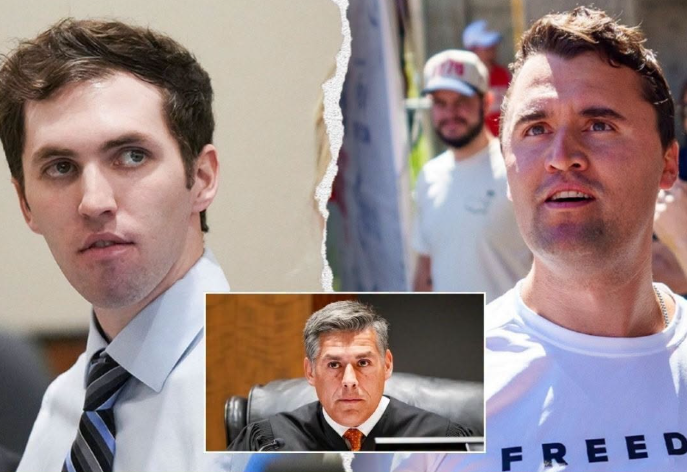
The case involving the assassination of Turning Point USA founder Charlie Kirk continues to wind its way through the court system.
The conservative youth leader was shot and killed during a TPUSA event at an Orem, Utah, college campus in September 2025. Tyler Robinson was charged with shooting and killing Kirk during the event.
Now, Robinson’s defense team is attempting to get him the best possible conditions for his upcoming trial but so far isn’t having much luck.
On Thursday, the Utah Supreme Court cleared the way for Robinson’s preliminary hearing to proceed as scheduled.
The hearing is set to begin Monday morning and is expected to continue throughout the week.
The state’s highest court declined to hear the defense’s appeal of two pretrial rulings by Judge Tony Graf, who is overseeing the case.
The appeal challenged the judge’s decisions allowing cameras in the courtroom and permitting certain hearsay evidence to be considered during the preliminary hearing, the Post Millennial reported.
“This matter is before the court upon a petition for permission to appeal from an interlocutory order,” the order stated.
“The petition for permission to appeal from an interlocutory order is denied. The motion to stay is deemed moot,” the state’s highest court noted further.
The question of allowing cameras in the courtroom has been a recurring issue throughout the pretrial proceedings.
Defense attorneys first sought appellate review of Graf’s rulings in May, after he denied their request for a blanket prohibition on cameras during the case.
The defense also asked Graf to postpone the preliminary hearing until the Utah Supreme Court decided whether it would hear the appeal, but that request was denied.
In its filing with the state’s high court, the defense again sought to delay the hearing pending the appeal, the PM noted further.
In an earlier ruling, Graf determined that requests for electronic media coverage would be evaluated on a hearing-by-hearing basis rather than through a blanket policy.
Under his order, news organizations must submit requests to use cameras or other electronic equipment at least 14 days before a scheduled proceeding, while either party may ask the court to restrict or prohibit such coverage. Graf retains final authority over those decisions, said the outlet.
Following the procedures established in the judge’s earlier ruling, the defense sought to bar cameras from covering the preliminary hearing.
On Tuesday, Graf rejected nearly all of the defense’s requests.
The judge granted only one motion, ruling that a media outlet that filed its request to take still photographs during the opening day of the hearing would not be permitted to do so because the application was submitted one day after the court’s filing deadline, noted the Post Millennial.
“On this record, controlled livestreaming and still photography may reduce reliance on secondhand or inaccurate descriptions by allowing the public and journalists to observe the same proceedings subject to the court’s decorum order, camera-placement restrictions, evidentiary rulings, and exhibit limitations,” he wrote in his ruling.
“The court does not rely on a generalized preference for electronic access; it finds that the specific benefits of accurate public observation of this preliminary hearing outweigh the incremental prejudice Defendant has identified from the requested coverage itself,” he noted further.
“In sum, the preliminary hearing is likely to generate extensive public discussion about Defendant,” Graf continued.
“Defendant has shown a substantial risk of prejudicial publicity generally, but has not shown on this record a reasonable likelihood that the requested controlled coverage separate—from publicity likely to occur regardless—will prejudice his fair-trial rights,” he said.
“Nor has Defendant shown sufficiently compelling reasons under Rule 4-401.01 to exclude the requested coverage, subject to the limitations and continuing supervision described in this order,” he added.