Olympic Skier’s Expression Behind Trump Sparks a Wave of Reactions Online
An Olympic skier unexpectedly became one of the most talked-about figures from a White House reception after a single photograph captured an expression that social media users quickly interpreted in a dozen different ways.
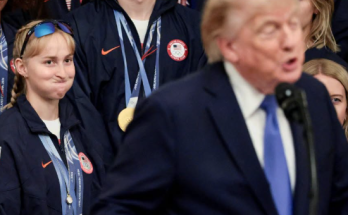
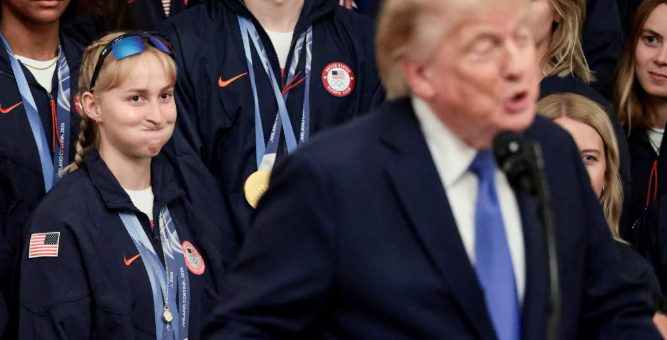
Elizabeth Lemley, a freestyle skier and Olympic medalist, was photographed standing behind President Donald Trump during a White House reception honoring Team USA athletes from the 2026 Milano Cortina Winter Olympic and Paralympic Games. A Reuters photographer captured Lemley at a moment when her lips appeared tightly pressed together and her gaze was fixed ahead, creating an expression that immediately caught the attention of viewers online.
The photograph quickly spread across social media, where users began offering their own interpretations of the moment. Some described Lemley’s expression as instantly relatable, while others jokingly suggested that her face appeared to be communicating more than words ever could. The image became a viral example of how a single candid photograph can take on an entirely different meaning once it enters the fast-moving world of online political commentary.
Of course, a photograph captures only one fraction of a second, and there is no way to know exactly what Lemley was thinking or feeling at the time. She did not make a public statement explaining her expression, and there is no evidence that the moment was intended as a political gesture. Nevertheless, social media users quickly supplied their own narratives, turning the image into a broader conversation about the political atmosphere surrounding the White House.
Comment sections filled with jokes, memes, and competing interpretations. Some users praised what they viewed as an unusually candid moment from an athlete standing at a highly publicized presidential event. Others pushed back against the political interpretation entirely, arguing that facial expressions can be misleading and that viewers should not assume they know what someone is thinking based on a single photograph.
The debate itself became part of the story.
What made the image particularly compelling was its simplicity. There was no speech, no political statement, and no obvious gesture designed for the cameras. Instead, there was simply a fleeting expression captured during a formal event. In the age of social media, however, those brief unscripted moments can become more powerful—and sometimes more politically charged—than carefully prepared remarks.
The White House reception was intended to celebrate the accomplishments of American athletes competing on one of the world’s biggest sporting stages. The event brought together Olympians and Paralympians whose performances represented years of training, sacrifice, competition, and perseverance. For many athletes, the occasion was an opportunity to celebrate their achievements and be recognized at the highest levels of government.
Yet amid the ceremony and formal photographs, Lemley’s expression became an unexpected focal point.
Supporters of Trump interpreted the online reaction differently from his critics, with some dismissing the viral discussion as an attempt to manufacture political controversy from an ordinary moment. Others argued that the image resonated precisely because viewers were free to project their own feelings onto it.
That tension highlights a larger reality of modern political photography: public figures are rarely photographed simply as people anymore. Their gestures, expressions, posture, and reactions can instantly become political symbols, particularly when they appear alongside a president whose every public appearance attracts intense scrutiny.
Whether Lemley intended to communicate anything at all is impossible to determine from the photograph. But the image nonetheless struck a chord with thousands of viewers, demonstrating once again how quickly an ordinary moment can become a cultural talking point.
In the end, the photograph was never accompanied by a speech or official declaration. It was simply one candid frame from a major White House celebration. Yet for many people online, that was enough to spark a conversation—and turn an Olympic athlete’s fleeting expression into one of the most widely discussed images from the event.