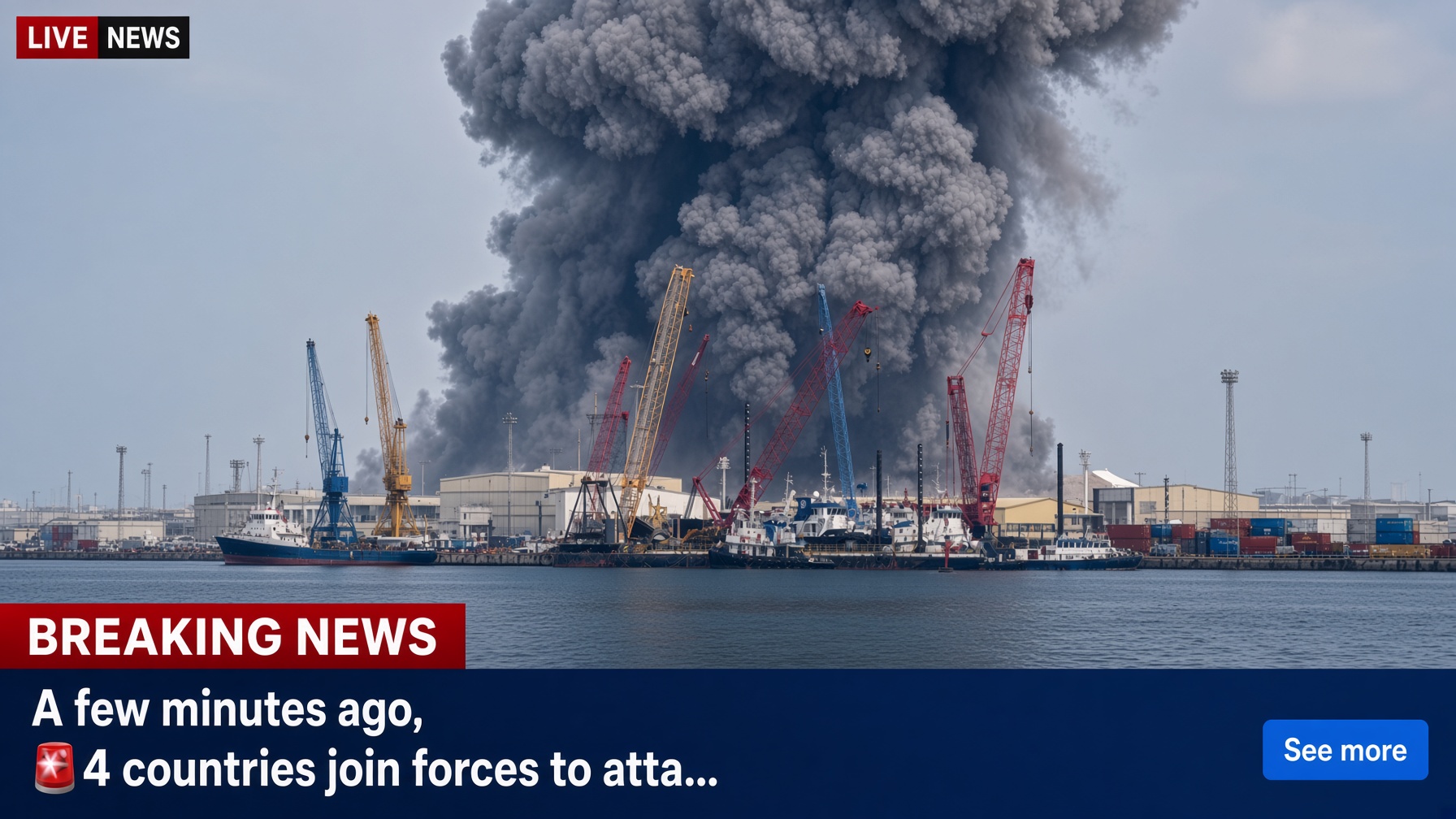
MANAMA, Bahrain — The Persian Gulf has returned to a volatile war footing after Iranian forces launched sustained waves of ballistic missiles and one-way attack drones at key military installations hosting American personnel across the region, triggering widespread air-defense interceptions and sending allied Gulf capitals into emergency defensive postures.
The coordinated strikes represent a decisive collapse of local containment, underscoring Tehran’s operational doctrine of projecting asymmetric retaliation directly into neighboring host states. Rather than absorbing kinetic exchanges within its own borders, Iran has systematically targeted the dense network of forward bases Washington maintains across Bahrain, Qatar, Kuwait, and the United Arab Emirates, transforming the entire Gulf littoral into an active combat theater.
Air-defense sirens sounded across the United Arab Emirates as regional early-warning networks tracked incoming salvos. UAE air-defense batteries, including advanced Terminal High Altitude Area Defense (THAAD) and Patriot systems, engaged aerial targets attempting to penetrate local airspace. Military planners placed special defensive emphasis around Al Dhafra Air Base, an indispensable hub south of Abu Dhabi that supports American aerial refueling, surveillance, and combat fighter operations.
While Iranian state media claimed precision impacts against U.S.-linked infrastructure at Al Dhafra, defense analysts and regional authorities urged caution, noting that accurate assessments of terminal damage and runway disruption require verified post-strike satellite analysis.
The offensive has placed Bahrain—the nerve center of American naval operations in the Middle East—under acute operational strain. The island kingdom hosts Naval Support Activity Bahrain, the operational headquarters of U.S. Naval Forces Central Command and the U.S. Fifth Fleet, which oversees maritime security operations across the Persian Gulf, the Red Sea, and the Arabian Sea. Alongside Shaikh Isa Air Base, Bahrain’s critical maritime facilities make it an inevitable target whenever Tehran expands its cross-border operations. Bahraini air-defense forces actively intercepted incoming aerial threats during the salvos, working in concert with shipboard Aegis combat systems operating in nearby waters.
Further north, Qatar’s Al Udeid Air Base faced similar pressure. Serving as the forward headquarters for U.S. Central Command (CENTCOM) and host to the combined air operations center that directs all coalition air traffic in the region, the sprawling installation remains one of Washington’s most valuable strategic assets. Independent commercial satellite imagery from earlier engagements has confirmed localized damage to logistics infrastructure at the base, and military personnel again retreated to hardened bunker complexes as interceptor missiles detonated in the skies overhead.
Kuwait has likewise found its territory drawn into the missile corridor. Interceptor batteries engaged projectiles targeting facilities that support American ground logistics and staging areas. The synchronized multi-axis attacks underscore a stark regional reality: Washington’s Gulf allies are increasingly forced to expend their high-end defensive missile stockpiles to repel attacks stemming from a conflict that threatens to overwhelm their sovereign airspace.
Compounding the military escalation are the severe economic risks surrounding the Strait of Hormuz. The narrow passage, which funnels roughly 20 percent of the world’s petroleum transit, sits squarely in the crosshairs of the confrontation. Repeated drone intrusions, kinetic skirmishes, and coastal missile alerts have caused commercial maritime traffic to slow to a near crawl.
Global shipping consortiums and energy majors have suspended routine transit or diverted vessels, while commercial maritime insurance underwriters have raised war-risk premiums to historic highs. Financial desks worldwide are monitoring the corridor with intense anxiety; any sustained naval interdiction or mine-laying effort within the chokepoint threatens an immediate supply shock to international crude markets, with instant consequences for global inflation benchmarks and manufacturing supply chains.
The multi-state assault highlights the fading utility of traditional diplomatic guardrails in the region. Iran has demonstrated both the logistical stockpile and the strategic intent required to bypass sovereign borders and strike deep into allied territory. Concurrently, the heavy concentration of American forces across the Gulf limits Washington’s ability to absorb attacks without executing direct kinetic counterstrikes.
For coalition command centers and regional armed forces, the immediate challenge remains managing magazine depth, intercepting incoming saturation salvos, and hardening exposed critical infrastructure. For international markets and diplomatic missions, the crisis has entered a dangerous phase where a single missile penetrating an allied air-defense screen could ignite an unconstrained, region-wide war that neither side can readily de-escalate.