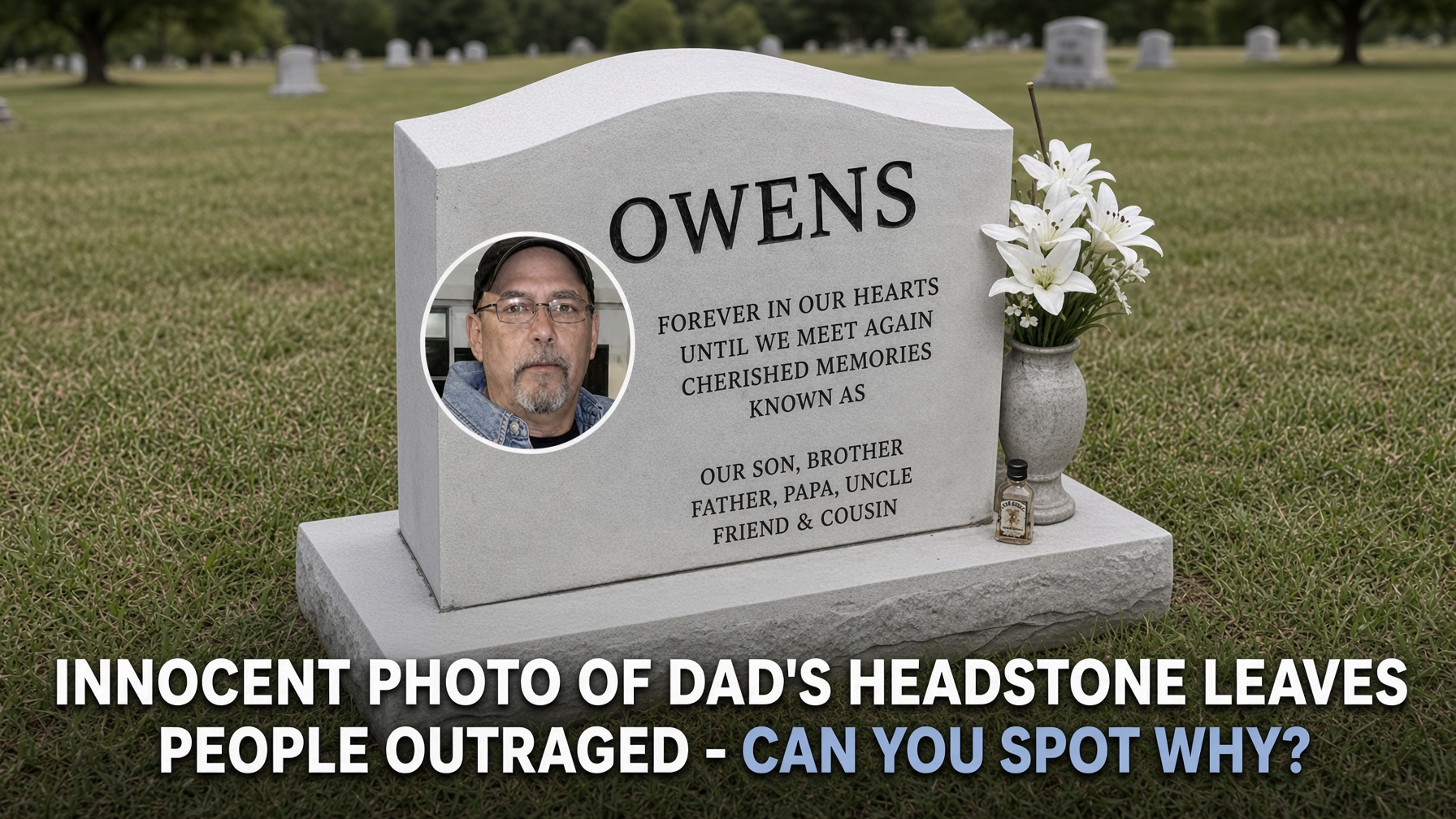
LOCAL DESK — A granite monument commissioned as a lighthearted tribute to a late father has ignited an extraordinary standoff between grieving relatives and cemetery administrators after the family embedded an acrostic profanity into the headstone’s carved inscription.
The dispute, which began as an intimate inside joke intended to reflect the deceased man’s irreverent sense of humor, has rapidly escalated into a clash over the boundaries of free expression within consecrated, communal spaces. The family maintains that the hidden message was an affectionate inside joke meant solely for those who knew him, while cemetery trustees argue they carry an administrative and moral mandate to preserve decorum across the grounds for all mourning visitors.
At the core of the conflict is a carefully drafted acrostic: a literary device in which the initial letters of consecutive lines or phrases, when read vertically, spell out a secondary word. Read horizontally, the epitaph presents an ostensibly conventional, poetic tribute celebrating family ties and personal memories. Read vertically from top to bottom, however, the leading letters form a blunt, vulgarity-laced phrase.
Family members emphasize that the acrostic was deliberately designed to remain subtle. To a casual passerby walking through the cemetery rows, the lettering appears indistinguishable from standard memorial prose. According to the family, the arrangement was a final, cathartic gesture crafted to capture the deceased’s personality—a man who valued sharp wit and unconventional humor over formal sentimentality.
“For us, this isn’t about disrespecting anyone or trying to shock the public,” a family representative explained. “It was about honoring who our father really was. It was our private way of saying goodbye with the kind of laugh he appreciated. It’s carved for him and for us, not for strangers to analyze.”
Cemetery trustees, however, take a fundamentally different view of their statutory and contractual responsibilities. Operators of municipal and private memorial parks routinely establish enforceable charters that govern headstone dimensions, structural materials, and the content of permanent inscriptions. These covenants are intended to prevent individual plots from compromising the solemnity of shared grounds or inflicting distress on adjacent families mourning their own losses.
Trustees argue that once an inscription is engraved into stone, it ceases to be entirely private. A cemetery is a communal repository of remembrance where hundreds of families converge during their most vulnerable moments. Officials fear that allowing an explicit profanity—regardless of its structural concealment—sets a damaging precedent, eroding the board’s capacity to reject offensive, defamatory, or overtly graphic text on future memorials.
Administrators have reportedly approached the family to discuss corrective alternatives, ranging from modifying the disputed letters to replacing the stone face entirely. The family has resisted those efforts, contending that altering the text would erase the emotional core of the tribute and dilute their father’s legacy.
The controversy highlights a complex intersection of property law, contract rights, and cultural attitudes toward bereavement. While plot owners generally hold the deed or long-term easement to a specific burial space, cemetery rules almost universally reserve the right of management to approve monument proofs before installation. If the acrostic was approved by administrators unaware of the vertical puzzle, legal scholars note that trustees could argue the contract was executed under a material omission or bad faith, empowering the board to demand alterations or remove the stone under nuisance clauses.
Conversely, free expression advocates point out that headstones represent deeply personal artifacts of grief. Modern memorial trends have increasingly moved away from austere scripture and rigid Victorian prose in favor of individualized, eccentric expressions—from etched motorcycles and sports team emblems to candid colloquialisms. When those tributes clash with institutional codes of conduct, the resulting friction leaves little room for easy compromise.
Neither side appears ready to yield. The family views any modification of the stone as an unacceptable censorship of their grief and a violation of their father’s wishes. Cemetery officials view the inscription as an unacceptable breach of community standards that threatens the peace of the grounds they are entrusted to protect.
As both parties evaluate their administrative and legal options, the headstone remains in place—a silent, granite manifestation of a modern dilemma over where private mourning ends and shared public space begins.