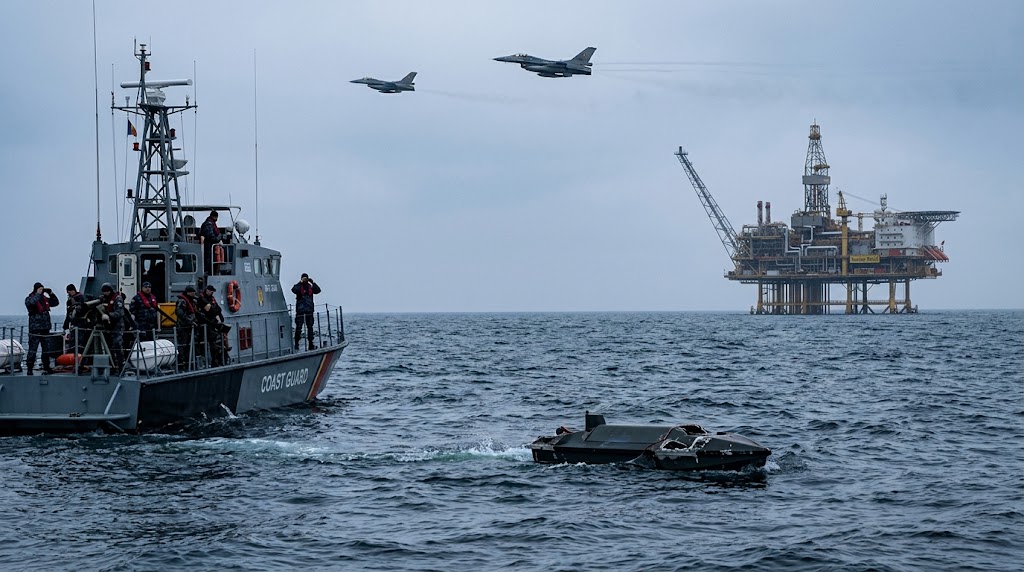
BUCHAREST, Romania — A major security operation unfolded in the Black Sea after Romania scrambled two F-16 fighter jets and deployed specialized naval teams to intercept and neutralize an explosive-laden maritime drone drifting near a critical offshore natural gas project.
The rapid military and explosive-ordnance response highlights the mounting security risks to critical energy infrastructure on NATO’s southeastern flank as spillover from the war in Ukraine continue to impact the maritime region.
Early Morning Alert
The incident began at approximately 6:28 a.m. local time on August 20, when a commercial vessel reported a small, unidentified unmanned craft drifting in the Black Sea. The drone was spotted just several hundred meters from the Neptun Alpha offshore platform—the nerve center of the strategically vital Neptun Deep gas project.
The site is located roughly 80 nautical miles east of the major Romanian port city of Constanța, well within Romania’s exclusive economic zone (EEZ), the Romanian Ministry of National Defence confirmed.
Recognizing the immediate threat to the offshore installation and its personnel, the Romanian Air Force scrambled two F-16 fighter jets on active air-policing duties to conduct visual reconnaissance and secure the airspace and waters surrounding the platform.
A High-Stakes Interception
Upon locating the small, low-profile maritime drone, one of the F-16s engaged the target, firing its onboard cannon in an attempt to neutralize the craft. While the strafing run successfully struck the target, the drone remained afloat, prompting the dispatch of a Romanian Coast Guard vessel carrying a specialized Naval Forces explosive-ordnance disposal (EOD) team.
Upon reaching the damaged vessel, EOD specialists conducted a high-stakes inspection. The Romanian Ministry of National Defence later confirmed the drone was carrying a live explosive charge, raising the severity of the encounter.
“Information gathered from the F-16 aircraft, including tracking and optical data, was analyzed alongside details collected by the responding naval crew,” military officials said. “The assessment confirmed the incident involved a single unmanned craft.”
The Navy’s EOD specialists safely neutralized the explosive device, preventing what could have been a catastrophic detonation. “Any detonation in such close proximity to the Neptun Alpha facility could have endangered lives, disrupted vital energy operations, or caused severe environmental and structural damage,” Romanian defense analyst Radu Tudor noted.
The Ministry of National Defence confirmed that no casualties were reported and the Neptun Alpha platform sustained no damage.
Unraveling the Drone’s Origins
The discovery has sparked an urgent investigation into where the explosive craft originated, though officials have been careful not to rush to conclusions publicly.
While the Black Sea has become a highly contested arena because of Russia’s war against Ukraine—marked by naval drones, drifting sea mines, and aerial reconnaissance—the origin of this specific craft remains unconfirmed.
Romanian Defense Minister Radu Miruță confirmed that Bucharest reached out directly to Kyiv through established communication channels. According to Miruță, Ukrainian officials confirmed that the drone did not belong to their forces.
Romania’s leadership has condemned the incident as a reckless threat to regional stability. President Nicușor Dan strongly criticized the “irresponsible” presence of explosive devices in busy maritime corridors, asserting that Romania will remain “on the highest state of alert” while working closely with its NATO allies to ensure maritime safety.
The Russian government has not publicly commented on the incident or addressed allegations regarding the drone’s origin.
A Pattern of Escalation
The encounter is not an isolated event. Earlier in August, Romanian naval EOD divers were forced to destroy two Gerbera-type unmanned aerial systems found drifting near the Neptun Deep perimeter. In those instances, Ukrainian authorities also confirmed they were not responsible for the stray systems.
The Black Sea has become increasingly hazardous for commercial shipping, energy operators, and coastal nations, with military debris and drifting ordnance frequently encroaching on sovereign territorial waters and exclusive economic zones.
Securing the Future of Neptun Deep
The proximity of the drone to the Neptun Deep project has underscored the vulnerability of Romania’s ambitious offshore energy plans.
Jointly developed by OMV Petrom and Romgaz, the Neptun Deep project is estimated to hold vast natural gas reserves, with production slated to begin in 2027. The project is seen as a cornerstone of Romania’s strategy to achieve energy independence, reduce reliance on Russian natural gas, and emerge as a key energy exporter in Central and Eastern Europe.
“The security of our offshore energy infrastructure is non-negotiable,” a spokesperson for Romania’s energy sector said. “This incident shows the invaluable role of our military’s rapid-response capabilities, but it also means we must invest even more heavily in maritime surveillance, radar systems, and physical defense barriers around these platforms.”
As Romania continues to navigate its position on NATO’s volatile southeastern flank, the Ministry of National Defence has vowed to maintain a robust, round-the-clock presence in the Black Sea, intensifying joint patrol operations with allied forces to safeguard energy infrastructure, commercial shipping lanes, and the thousands of civilian offshore workers in the region.